
Tech Support with Heart: Smart Solutions, Human Touch
Combining expertise and empathy to deliver seamless, stress-free technical support.
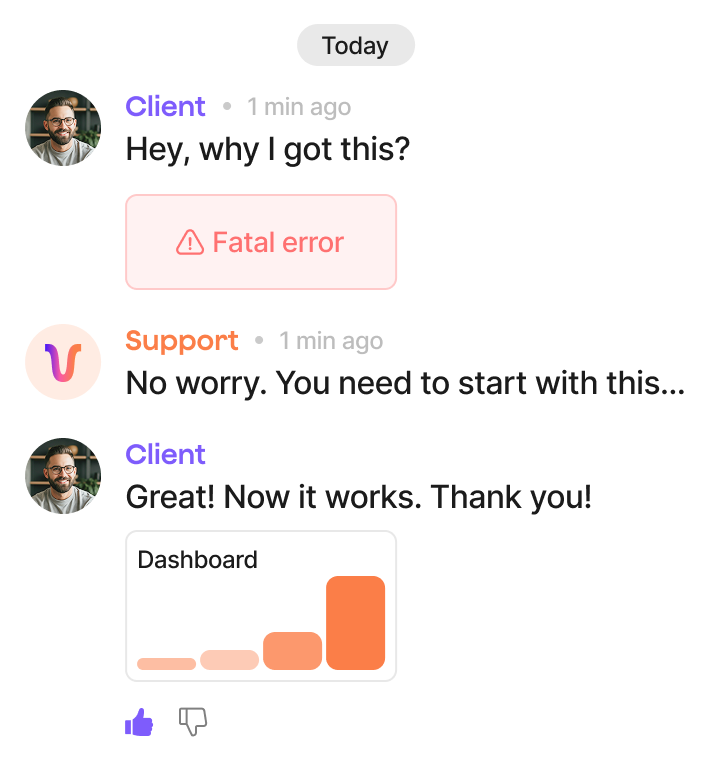
At VoiceTeam, we go beyond traditional tech support—we provide fast, knowledgeable assistance with the warmth of real human connection. Our culturally fluent, bilingual teams help customers navigate complex technical issues with patience, precision, and care.
Tier 1 to Tier 3 diagnosis for connectivity, device and software faults, working to your escalation rules and handing off cleanly when a fault belongs with your engineers. Our AI-assisted support models have reduced troubleshooting time by 40% and improved first-call resolution.

From voice and chat to email and social media, we offer omnichannel technical support that meets customers wherever they are.

Our highly trained teams specialize in Level 1, Level 2, and Level 3 technical support—ensuring fast, accurate problem resolution while keeping customers at ease.

We integrate AI-powered analytics with expert human interactions, reducing resolution times and improving customer satisfaction.

Need to expand your support capabilities? Our agile workforce scales quickly to meet your evolving technical needs.
Tier 1 takes the first contact: identifying the fault, working through known fixes and resolving what can be resolved on the spot.
Tier 2 handles faults that need deeper diagnosis, configuration or account-level access.
Tier 3 is specialist work, close to your product or network engineers.
Our teams work across all three, to the rules you set.
Where the line between each tier falls is your decision, and it is the first thing worth settling. Some companies want Tier 1 resolving as much as possible on first contact. Others want a fast, well-documented handoff so their engineers receive a clean ticket. Either works. What causes trouble is leaving it undefined, because then every agent draws the line in a different place and your customers notice.
Ticket triage sits underneath all of it. A contact that is categorized correctly when it arrives reaches the right tier the first time, and the customer does not have to explain the problem twice. It is also where first contact resolution is decided. A ticket routed to the wrong tier, or closed before the fault is actually fixed, comes back as a second contact from a less patient customer.
The handoff is defined before launch, not improvised. Your escalation rules decide what goes to your engineers, when, and with what already established. The customer is told what is happening rather than left to chase it.

Our AI-assisted support models have reduced troubleshooting time by 40% and improved first-call resolution rates.

Bilingual agents in the Dominican Republic, and our own staff at a partner team in the Philippines, deliver tech support tailored to U.S. customers.

We use real-time data insights to streamline troubleshooting while prioritizing the human experience in every interaction.

From telecom and fintech to SaaS, we deploy specialized tech teams that understand your industry’s unique challenges.
Yes. Our teams in the Dominican Republic cover North American business hours, and our staff in the Philippines, through a partnership there, cover evenings and weekends. Agents work across phone, chat, email and social on the same account, with the same training and the same view of the customer.
Round-the-clock tech support comes from staffing the overnight hours with people working their own daytime. A single team stretched through the night is a tired team at exactly the hour your customers are least patient, because a contact at three in the morning usually means something has stopped working.
Keeping every channel with one team matters more in technical support than almost anywhere else. A customer who starts in chat, gets stuck and then calls should not have to repeat the troubleshooting they have already done. When voice sits with one provider and chat with another, that history is lost and your escalation rules get interpreted twice. If most of your volume is written, chat and email support covers how those channels run.
Our Dominican Republic teams are bilingual in English and Spanish, and Spanish is a first language for them. A customer who switches to Spanish partway through stays with the same agent, so the diagnosis carries on from where it was. For how nearshore delivery compares with offshore and in-house, see nearshore call center outsourcing.
It means your support team recognizes an incident from the pattern of incoming contacts, tells your engineers early, and changes how every related contact is handled while the fix is underway. Customers get one consistent explanation, and the fix goes into the knowledge base so the next agent can resolve it faster.
Frontline agents often see an outage before a dashboard does. Several customers in an hour describing the same symptom is an incident, whether or not anyone has declared one yet. Resolving each of those contacts in isolation is how one fault turns into hundreds of separate tickets.
Once an incident is confirmed, the work changes. Agents move to the message your team has approved and stop troubleshooting what is already known to be broken.
The part that lasts is the knowledge base. Every resolved incident and every workaround should end up written down where the next agent will find it. One of the testimonials on this page is from a U.S. mobile carrier whose knowledge base our team built for their entire organization. For what unresolved issues and slow escalations cost in lost customers, read the cost of bad tech support.
AI helps with routing, with real-time data that speeds up troubleshooting, and with spotting patterns across tickets. People stay accountable for the outcome: diagnosing faults that match no known pattern, handling customers who are frustrated or close to leaving, and deciding when something needs your engineers. The technology makes agents faster, and the agent owns the ticket.
Automation handles the predictable part of tech support well: password resets, known faults with a documented fix, status questions during an outage. It struggles with the contacts that matter most, where the problem is new, the customer has already tried the obvious fixes, or the account is one you cannot afford to lose.
A customer who has been through a chatbot loop and then reaches a person needs that person to pick up the history and go straight to the next step. If you already run a chatbot or a self-service portal, the useful question is what happens when it fails, and that handoff is one of the things we agree with you at setup, alongside your escalation rules and tooling.
Yes. Onboarding and troubleshooting questions are answered by agents trained on your product, and our tech support covers connectivity, device and software faults. A customer who gets stuck in their first week reaches someone trained on the product they are trying to set up.
The first weeks decide a lot. A customer who cannot get a product working early rarely reports it as a setup problem. They just stop using it. Onboarding support is one of the cheapest places to prevent that, because the questions are predictable and the answers can be written down once and used many times.
For connected devices and telecom services the work is more hands-on: power cycles, cabling, network settings, compatibility, and working out whether the fault sits with the device, the connection or the account. In most programs that is Tier 1 and Tier 2 work, and a clear, patient explanation does as much as technical knowledge. VoiceTeam has supported telecom brands since 2008, so this is familiar ground.
If you sell software and want support across the whole customer operation, our technology page covers SaaS programs specifically.
Measures agreed before launch and reported monthly, typically first contact resolution, handle time, customer satisfaction and quality assurance scores against your own standard. Quality monitoring that runs to the COPC framework we are certified against. Agents who stay long enough to learn your product, because in tech support product knowledge is most of the job.
The usual failure in enterprise tech support is consistency. The first month goes well. The problems arrive later, when the agents trained at launch have left and their replacements are learning on your customers. We run open book management, so people stay long enough to be worth the training we put into them, and what they learn stays on your account.
On cost, the useful starting figure is your current cost per contact, including recruitment, the training you repeat every time someone leaves, and the contacts nobody answers. Our cost of ownership calculator compares that with a nearshore team.
A program starts with one working session: your contact volumes and when they arrive, your tooling, your escalation rules, what an agent may decide alone, and what your quality standard is. Then training on your product and systems, a pilot on a defined queue, and scale from there. Growing for a launch or a seasonal peak means adding agents to an account that already exists and training them alongside the team running it.
Tech support outsourcing means handing some or all of your customer-facing technical support to an external team that works to your processes. The provider supplies the people, the coverage, the training and the reporting. You keep the product, the engineering and the escalation rules. VoiceTeam runs tech support programs from its main operation in Santiago in the Dominican Republic.
Yes, including nights, weekends and US holidays. Our Dominican Republic teams cover North American business hours, and our staff in the Philippines, through a partnership there, cover evenings and weekends. The overnight shift is staffed by people working their own daytime, so the agent answering at 3am is as alert as the one answering at 3pm.
Yes, through our Dominican Republic teams, who work in English and Spanish. Spanish is a first language for them, and a customer who switches to Spanish stays with the same agent instead of being moved to a second queue. In troubleshooting that matters, because the details of what a customer has already tried are easy to lose in a transfer.
Connectivity, device, account and software faults, from first-contact troubleshooting through Tier 3, plus setup and onboarding. Our tech teams support companies in telecom, fintech and SaaS, and each program is trained on that company’s own product, systems and escalation rules.
New agents join an account that already exists and are trained alongside the team running it, instead of a new team being recruited against your peak. Quality monitoring runs to the COPC framework we are certified against, and results are reported monthly against the measures agreed with you before launch.
 Say
Say 
